Feb 13, 2018
 For the 2018 Program Year, the Cost category will make up 10% of your MIPS Final Score. Cost is mandated to move to 30% of your MIPS Final Score for Program Year 2019. This gradual shift makes understanding the Cost category, and the composing measures, increasingly important when trying to stay competitive within the MIPS quality program. In addition to increasing the Cost category weight, the Final Rule also increased the 2018 PY final score threshold to 15 points (from 3 points in 2017) while maintaining the exceptional performance threshold at 70 points or higher. Achieving the threshold of 15 points requires MIPS eligible clinicians to fully participate in at least one of the MIPS categories to avoid the 5% negative adjustment factor in payment year 2020.
Join us March 8th from 12-1 pm for QPP Year 2: Cost Deep Dive. During the webinar we will be reviewing changes to the Cost category for Year 2. In addition to reviewing the basics of this category we will also take a closer look at steps you can take to utilize feedback reports to target the best interventions to impact your scores.
QPP Year 2: Cost Deep Dive March 8, 2018 12-1 p.m. ET
Contact our experts at Kentucky REC with your questions about the Quality Payment Program. Our team of experts is here to help: 859-323-3090
Feb 6, 2018
 From the January 2018 OCR Cybersecurity Newsletter:
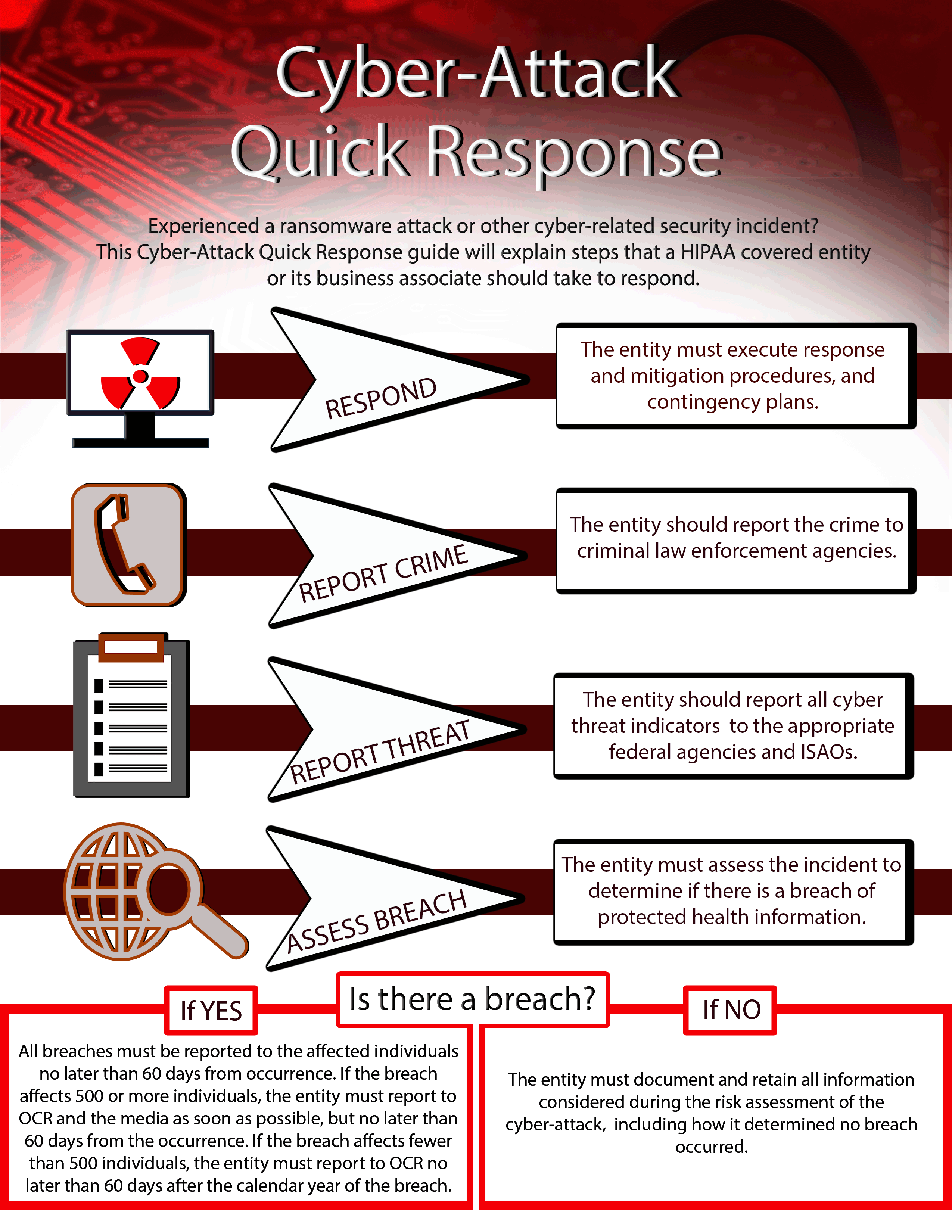
Incidents of cyber extortion have risen steadily over the past couple of years and, by many estimates, will continue to be a major source of disruption for many organizations. Cyber extortion can take many forms, but it typically involves cybercriminals’ demanding money to stop (or in some cases, to merely delay) their malicious activities, which often include stealing sensitive data or disrupting computer services. Organizations that provide necessary services or maintain sensitive data, such as Healthcare and Public Health (HPH) sector organizations are often the targets of cyber extortion attacks. The HHS Office for Civil Rights (OCR) published a checklist[1] and accompanying infographic[2] to assist HIPAA covered entities and business associates on how to respond to a cyber-attack.
Ransomware is a form of cyber extortion whereby the attackers deploy malware targeting an organization’s data that renders the data inaccessible, typically by encryption. The encryption key must be obtained from the ransomware attackers to decrypt the data. The ransomware attackers demand payment, often in the form of cryptocurrency (e.g., Bitcoin) for that decryption key. Unfortunately, paying ransom to the attackers may not result in an organization getting its data back. Or, once an organization pays the ransom, the attackers may provide a key to only decrypt a portion of the data and ask for additional ransom to decrypt more data. OCR published a fact sheet that provided guidance on preventing and responding to ransomware attacks for HIPAA covered entities and business associates.[3]
Additional examples of cyber extortion include Denial of Service (DoS) and Distributed Denial of Service (DDoS) attacks. These types of attacks typically direct such a high volume of network traffic to targeted computers that the affected computers cannot respond and may appear down or otherwise inaccessible to legitimate users. In this type of attack, an attacker may initiate a DoS or DDoS attack against an organization and demand payment to halt the attack, or the attacker could threaten an attack and demand payment to not initiate the attack. OCR highlighted DoS and DDoS attacks in a prior cybersecurity newsletter, which included tips on identifying possible attacks as well as steps to take in the event of an attack.[4]
Another type of cyber extortion occurs when an attacker gains access to an organization’s computer system, steals sensitive data from the organization, and then threatens to publish that data. The attacker uses the threat of publically exposing an organization’s sensitive data, which could include protected health information (PHI), to coerce payment. In this type of attack, the attacker already has the organization’s data and can sell that data to other malicious persons even after the ransom is paid. A variation of this type of attack occurs when an attacker steals sensitive data from an organization and then deletes that data from the organization’s computers. The attackers then contact the organization informing them that its data has been deleted, but will be returned in exchange for payment. Again, payment of the ransom is no guarantee that an organization will get its data back. In fact, there have been instances where one attacker has stolen and deleted an organization’s data while leaving a demand for payment only to have a second attacker gain access to the same computer system and overwrite the payment demand of the first attacker. In this circumstance, the second attacker didn’t even have the data, so the organization has no chance of retrieving data from the second attacker.
Although cyber attackers constantly create new versions of malicious software and search for new vulnerabilities to exploit, organizations must continue to be vigilant in their efforts to combat cyber extortion. Examples of activities organizations should consider to reduce the chances of being a victim of cyber extortion include:
- Implementing a robust risk analysis and risk management program that identifies and addresses cyber risks holistically, throughout the entire organization;
- Implementing robust inventory and vulnerability identification processes to ensure accuracy and thoroughness of the risk analysis;
- Training employees to better identify suspicious emails and other messaging technologies that could introduce malicious software into the organization;
- Deploying proactive anti-malware solutions to identify and prevent malicious software intrusions;
Patching systems to fix known vulnerabilities that could be exploited by attackers or malicious software;
- Hardening internal network defenses and limiting internal network access to deny or slow the lateral movement of an attacker and/or propagation of malicious software;
- Implementing and testing robust contingency and disaster recovery plans to ensure the organization is capable and ready to recover from a cyber-attack;
- Encrypting and backing up sensitive data;
Implementing robust audit logs and reviewing such logs regularly for suspicious activity; and
- Remaining vigilant for new and emerging cyber threats and vulnerabilities (for example, by receiving US-CERT alerts and participating in information sharing organizations[5]).
For more information on cyber security resources from OCR, please visit here.
A pdf of this newsletter may be found here.
An archive of OCR’s monthly cybersecurity newsletters may be found here.
OCR’s cybersecurity guidance may be found here.
__________________________________
[1] Cyber Attack Checklist
[2] Cyber Attack Quick Response Infographic
[3] Ransomware Fact Sheet
[4] December 2016 Cyber Newsletter
[5] February 2017 OCR Cyber Awareness Newsletter
For help in making your practice more secure, contact our Privacy and Security experts at Kentucky REC by calling us at 859-323-3090.
Feb 2, 2018
 Attestation for Program Year 2017 is happening now. Here are some recommendations to help you successfully attest.
The Kentucky Medicaid EHR Incentive Program is accepting attestations for Program Year 2017 Meaningful Use. The deadline to submit an attestation for Program Year 2017 is 11:59 pm, March 31, 2018. The user manual for Program Year 2017 is located on the EHR website here.
Schedule a meeting with your Health IT Advisor to submit 2017 MU Attestations.
Items to Attach to your MU Attestations (Save as a PDF):
- Patient Volume Form
- Invoice/Purchase Order from Vendor
- CEHRT ID from CHPL website
- Meaningful Use reports/CQMs
- Public Health participation agreements/addendums (KHIE or other specialized registries)
- Payment Reassignment Letter (If provider is registered to have payment assigned to group NPI)
Make sure these items are saved and together at time of attestation to ease the process. A complete checklist can be found here. Please contact your Health IT Advisor to schedule a meeting to submit your 2017 Meaningful Use attestations as soon as possible.
2018 Meaningful Use Information
For 2018, the EHR reporting period for all participants is a minimum of any continuous 90 days from January 1 through December 31, 2018. Now is a great time to begin running your Meaningful Use reports for 2018 and review with your Health IT Advisor.
You will have the choice in attesting to:
- Modified Stage 2: Providers may attest to objectives and measures using EHR technology certified to the 2014 Edition, 2015 Edition, or a combination of the two.
OR
- Stage 3: Providers may attest to objectives and measures using EHR technology using a combination of 2014 and 2015 Edition or 2015 Edition.
Contact our experts at Kentucky REC with your Meaningful Use questions at 859-323-3090.
Jan 24, 2018
 Join us for our second webinar of 2018 on the Quality Payment Program. We will go over the Quality Category in general, highlighting changes for Year 2. We will also take a closer look at moving beyond just capturing data, going over initial steps you can use in your practice to drive quality improvement.
Join us for this informative webinar Thursday February 8th from 12-1 p.m. EST
Contact us with your Quality Payment Program and MIPS questions. Our experts are here to help: 859-323-3090
Jan 26, 2018
 You are invited to attend the Kentuckiana Health Collaborative’s upcoming annual conference, Connecting Mental and Physical Health: Successful Models of Integrated Care. The KHC brings together healthcare purchasers, payers, providers, and consumers to work collaboratively towards the triple aim goals. This year’s conference will focus on the latest evidenced-based approaches, best practices, and successful models of addressing mental health and substance use disorders among primary care providers, employers, and the community.
Tuesday, March 13, 2018 – Evening conference reception
Wednesday, March 14, 2018 – Full day annual conference
Location: The Olmsted, 3701 Frankfort Ave, Louisville KY 40207
Please see the conference flyer for details.
Register here
Questions? Email mganote@khcollaborative.org
Jan 23, 2018
 MIPS Data Submission: Practical Advice for Small Group Practices and Solo Practitioners
January 23 11:00 a.m. – 12 p.m. EST
Register Here
January 25 3:30 p.m. – 4:30 p.m. EST
Register Here
This webinar, hosted by IMPAQ on two separate days for your convenience, will feature a panel of experts familiar with the range of data submission options and focus on step-by-step processes on how to submit improvement activity and other MIPS data to CMS.
Contact Kentucky REC at 859-323-3090 with your MIPS questions. Our experts are here to help.