Mar 31, 2022

The number of healthcare data breaches reported in 2021 was record-breaking. Cyber-criminals continue to up their game at accessing and exfiltrating electronically protected health information. The HIPAA Security Rule sets forth safeguards that all covered entities must implement. Adopting these safeguards is a key factor for decreasing the likelihood of a cyberattack leading to a data breach and protecting your organization from an unfavorable outcome if ever audited or investigated.
Webinar – Important HIPAA Security Safeguards for Cyberattack Defense
Wednesday, May 25, 2021 12:00 PM ET
Call 859-323-3090 or email Kentucky REC HIPAA Privacy and Security experts with your questions, or if you want to talk to an advisor to schedule a Security Risk Analysis with us this year.
Feb 12, 2022
 Excerpted from Ark Valley Voice (an online news source in Central Colorado):
Ahead of SURS Program Expiration, Bennet, Cassidy, Welch, Burgess Introduce Legislation to Extend Technical Support Program for Clinicians in Small Practices
Posted by Jan Wondra | Feb 4, 2022
On Wednesday February 2nd, U.S. Senators Michael Bennet (D-Colo.) and Bill Cassidy (R-La.), and U.S. Representatives Peter Welch (D-Vt.) and Michael Burgess (R-Texas) introduced the “Small Practice, Underserved, and Rural Support Program Extension Act” of 2022 (SURS Extension Act). The extension is important to medical practices throughout the nation, particularly in small practices, underserved areas, and rural areas.
The bipartisan, bicameral SURS Extension Act would reauthorize the Centers for Medicare & Medicaid Services (CMS) technical assistance initiative for clinicians in small practices participating in the Quality Payment Program (QPP) known as the Small, Underserved, and Rural Support (SURS) program.
The SURS program is set to end on February 15, 2022 if Congress does not take action to extend it.
“Extending the SURS program is an important bipartisan effort that will help small providers in Colorado and across the nation,” said Bennet. “Our legislation will extend the program, helping small and many rural providers move towards quality payment models and, in turn, lowering costs and improving outcomes for patients. I’ll continue working with my colleagues to ensure we secure an extension of this vital program.”
“Small health care providers in rural and underserved areas don’t have the big administrative staffs to deal with complex Medicare reporting requirements,” said Dr. Cassidy. “This legislation gives support to small practice docs so they can focus on providing the best quality care for their communities.”
“This legislation extends much-needed help for the small and rural health care providers that are at the heart of Vermont’s health care system,” said Welch. “Extending the QPP-SURS program helps make sure that rural clinicians get the technical assistance they need to provide high quality affordable and accessible care to Medicare patients.”
“Our health care heroes have put it all on the line over the duration of this pandemic,” said Dr. Burgess. “We have a responsibility to support them in every way we can. This program has been successful in providing the technical support needed to navigate reporting requirements for rural and underserved physicians who want to transition to value-based care. We must provide this support to physicians who want to modernize their models of care.”
The SURS ACT was signed into law in May 2015, under the Obama administration, known as the Medicare Access and CHIP Reauthorization Act of 2015 (MACRA), which established the Quality Payment Program (QPP). MACRA authorized and funded the SURS program, a program and practice-level technical assistance program for Merit-based Incentive Payment System (MIPS) eligible clinicians in practices of 15 or fewer providers, with priority given to practices in rural areas, areas with a health professional shortage, and medically underserved areas. Since 2017, the SURS program has provided direct support to an average 107,250 clinicians annually.
“We commend the introduction of the SURS Extension Act and encourage its swift passage. Physicians in rural parts of the state have and will continue to depend on this program to help them provide the quality, cost-effective care that Medicare patients need whether they’re from Colorado’s Eastern Plains or the Western Slope. The technical assistance provided by the program is incredibly valuable to ensure that small practices in rural and underserved areas have the support and tools necessary to succeed in the continuously changing MIPS program,” said Mark B. Johnson, M.D., MPH, President of the Colorado Medical Society.
Readers should know that the program is endorsed by: American Academy of Family Physicians, American Academy of Home Care Medicine, American Association of Hip & Knee Surgeons, American College of Physicians, American Health Quality Association, American Medical Association, American Osteopathic Association, Alliant Health Solutions, Altarum, Civitas Networks for Health, Colorado Medical Society, Comagine Health, Healthcentric Advisors, Medical Group Management Association, MetaStar, Inc., National Coalition on Health Care, National Partnership for Women & Families, Northwestern University Feinberg School of Medicine, Qsource, Quality Insights, Primary Care Collaborative, Stratis Health, TMF Health Quality Institute, UK HealthCare, and Vermont Medical Society.
In a letter in support of the SURS Extension Act, the above group of organizations wrote:
“[Payment] reform programs are complex, and clinicians require supplemental resources and guidance to meet the substantial quality and cost containment aspirations of payment models…The COVID-19 pandemic has further exacerbated this issue by restricting the availability of these clinicians to understand updates and changes to payment reform programs. The SURS Extension Act extends the QPP-SURS program until 2027 and ensures that small practices in rural and underserved areas have the support and tools necessary to succeed in the MIPS program.”
You can access the original Ark Valley Voice article HERE.
The full bill text is available HERE.
As a subcontractor to Altarum Institute of Michigan, Kentucky Regional Extension Center exclusively serves and supports the eligible providers in Kentucky. However, after five years of support, the QPP SURS technical assistance grant will end on February 15, 2022. You can read our blog post about the end of the SURS technical assistance HERE.
Contact the expert advisors at Kentucky REC for all your QPP, MIPS, and APM questions. We’re here to help: 859-323-3090.
Feb 16, 2022

As the pandemic becomes endemic, we’re looking toward the future of access to healthcare. Can you see Telemedicine being a permanent part of your practice? Did you know that some of the service codes we have been using may not be included in the permanent Medicare Telehealth services list? Did you know the demographic using telehealth audio/video technology is mostly women ages 25-40?
Join us for our upcoming telehealth webinar where our experts will discuss Medicare’s additions to the permanent telehealth list, how to navigate service codes that are not included in Medicare’s updated lists, what to expect from the state telehealth committee, and more.
Webinar – NAVIGATING TELEHEALTH AS THE PANDEMIC MOVES TO ENDEMIC
TUESDAY MARCH 22 12:00 – 12:45 PM ET
Contact the experts at Kentucky REC with all your Telemedicine and Telehealth questions. We’re here to help: 859-323-3090.
Feb 14, 2022
Now, early in the year, is the perfect time to begin reviewing your organization’s list of eligible clinicians in CMS’s Quality Payment Program. This is one of the first steps in preparation for a successful performance in the QPP. Join the Kentucky REC’s panel of knowledgeable advisors as they provide valuable programmatic details on the eligibility process for the QPP.
We will discuss eligibility criteria, MIPS determination periods, special statuses, participation information, reporting options, and how your eligibility can change throughout the year. We will show the various ways to check eligibility, and which area is definitive when finalizing which clinicians are required to submit. Also, learn how some clinicians may opt-in to the QPP to take advantage of their high-performing status within the program.
QPP YEAR 6 WEBINAR: ELIGIBILITY – Understanding Clinician & Reporting Eligibility
WEDNESDAY MARCH 16th 12:00 – 1:00 PM ET
Contact the experts at Kentucky REC for all your QPP, MIPS, and APM questions. We’re here to help: 859-323-3090.
Jan 25, 2022
 What are the SAFER Guides?
Safety Assurance Factors for EHR Resilience Guides (SAFER Guides) were developed and released by the ONC in 2014 and updated in 2016. This series of nine user guides support healthcare organizations in their ability to address EHR safety. Collectively, the SAFER Guides help healthcare organizations conduct self-assessments to optimize the safety and safe use of EHRs in three areas – Foundational, Infrastructure and Clinical Process. The SAFER Guides are intended to be used by EHR users, developers, patient safety organizations, and those who are concerned with optimizing the safe use of Health IT.
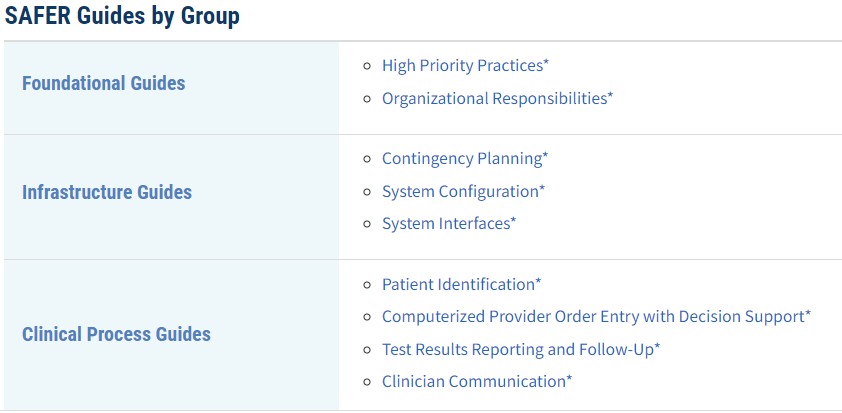
Source:HealthIT.gov
How do SAFER Guides self assessments help my organization?
By completing a self-assessment using the SAFER Guides, providers can help develop a “culture of safety” within their organizations and ensure they are responsible operators of technology tools, including certified health IT products, which they use in the delivery of care.
Is my organization required to complete a SAFER Guides assessment?
On August 13, 2021 CMS issued the final rule for fiscal year (FY) 2022 Medicare Hospital Inpatient Prospective Payment System (IPPS) and Long-Term Care Hospital (LTCH) Prospective Payment System (PPS). The final rule updates Medicare payment policies and rates for operating and capital-related costs of acute care hospitals and for certain hospitals and hospital units excluded from the IPPS for FY 2022. Under the rule, a new “SAFER Guides Measure” has been added to the Protect Patient Health Information objective.
Hospitals must attest to having completed an annual assessment of all nine guides in the SAFER Guides measure.
What are the Medicare Promoting Interoperability Program attestation requirements for the SAFER Guides measure?
For Calendar Year (CY) 2022, this measure requires an eligible hospital or CAH to attest to having conducted an annual self-assessment of all nine SAFER Guides at any point during the calendar year in which the EHR reporting period occurs. The measure will be a “yes” or “no” requirement, but it will not be scored, and it will not affect the total score for the Medicare Promoting Interoperability Program.
How is a SAFER Guides assessment completed?
In order to complete a self-assessment of the SAFER Guides, CMS expects that each eligible hospital or CAH will complete the checklist of recommended practices included at the beginning of each SAFER Guide. Following the checklist, a practice worksheet provides the rationale for, and examples of, how to implement each recommended practice, along with likely sources of input into the assessment of each practice, and fillable fields to record follow-up actions.
Where can I find the SAFER Guides assessment tools?
The SAFER Guides assessment tools and additional information are available HERE.
Is my organization still required to conduct a Security Risk Assessment (SRA)?
A security risk assessment must be conducted by all covered entities per the HIPAA Security Rule, regardless of participation in the Medicare Promoting Interoperability Program. If participating in the Medicare Promoting Interoperability Program, eligible hospitals or CAHs must attest to having completed both an SRA and a SAFER Guides assessment.
Resources:
Federal Register Final Rule
SAFER Guides Information
Call 859-323-3090 or email Kentucky REC our HIPAA Privacy and Security experts with your questions. We’re here to help.
Jan 13, 2022
Each new year brings challenges and opportunities within the world of healthcare. The last several years have been unprecedented in the level of those challenges, with clinicians and healthcare workers willingly stepping into the gap to provide much needed care for some of our most fragile patients. At the Kentucky Regional Extension Center, we appreciate your dedication and commitment to the communities you serve.
2022 brings new regulatory changes and updates to CMS’s Quality Payment Program as well. From limiting bonus potential in the Quality performance category, to increased weighting and addition of 5 new Cost measures, to updates with Promoting Interoperability, and additional insights into the implementation of MIPS Value Pathways (that will soon be replacing Traditional MIPS), more change is on the horizon. Now, more than ever, is the time to optimize your Health Information Technology, gain understanding around your data, and streamline workflows and processes to maximize your performance potential and improve outcomes.
Join us for our next webinar where we will explore these programmatic challenges and how to turn them into opportunities for improvement when you partner with the expert advisors at the Kentucky Regional Extension Center.
QPP Year 6 Overview: Foundations of Success in the QPP – February 16th at 12pm Eastern.
QPP YEAR 6 WEBINAR: 2022 PROGRAM OVERVIEW
WEDNESDAY FEBRUARY 16th 12:00 – 1:00 PM ET
Contact the experts at Kentucky REC for all your QPP, MIPS, and APM questions. We’re here to help: 859-323-3090.

